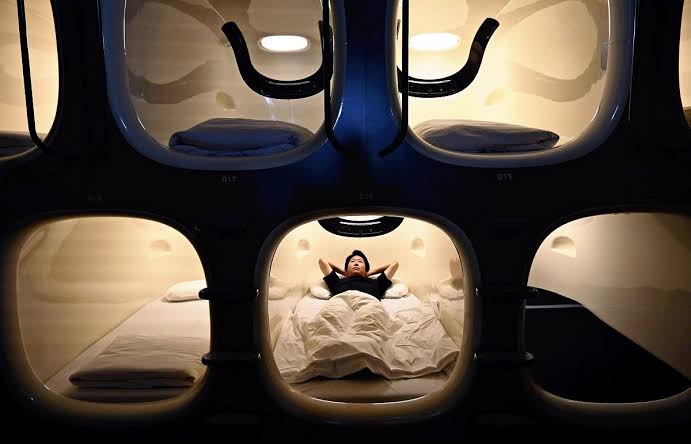
These four Tokyo hotels have little or no kitchen of their own, and the guide says so plainly. What holds them up is a counter on the ground floor, the block around the door or a market street a short walk away. Two are separate addresses within larger hotel groups, which is noted below. Nothing here grows its own food.
Four Tokyo addresses where the support stands at the door or on the next street.
Almond Hostel & Cafe Shibuya
Shibuya, Tokyo, Japan
A capsule house with no kitchen upstairs, so everyone comes down to the ground floor
What the kitchen leans on
Downstairs there is a cafe, and that is the whole of it. The sleeping floors hold capsules and washrooms, not cooking space, so the house leans on the counter at street level. Bread and coffee come from that room, and guests take the stairs down rather than carrying anything up to the berths.
Who grows or catches it
Staff at the ground floor counter run the cafe, and the supply behind it is a city supply: bakeries and roasters working within Tokyo, delivering to a small room on a busy Shibuya street. Nothing is grown by the house, and no farm stands behind it, which is normal for a capsule address.
What travels furthest
Coffee travels furthest by a wide margin, since none is grown anywhere near Tokyo. Wheat for the bread is largely imported as well, so the two things the house leans on hardest both begin their journey outside Japan.
Bring this upCheck the hours of the ground floor counter before you book a late arrival, because when that room closes the building has no other place to eat.
Menu read · June 2027
MyCUBE by MYSTAYS Asakusa Kuramae
Kuramae, Tokyo, Japan
A capsule address leaning on the coffee counters and bakeries of the surrounding blocks
What the kitchen leans on
Kuramae is the answer here. The house has no farm and no kitchen garden, and the eating happens in the streets around it, where roasters, small bakeries and coffee counters have filled the old wholesale quarter. Guests walk out of the door and into that block, which is what this address actually leans on.
Who grows or catches it
Independent roasters and bakers hold those shopfronts, most of them working single rooms with equipment at the front and the owner behind it. Kuramae kept its craft trades when the wholesalers thinned out, and the district now runs on small operators. This building belongs to a hotel group and is one separate address within it.
What travels furthest
Green coffee arrives from other continents before it is roasted on the block, so the thing the quarter is known for is also the thing that travels furthest. Flour comes largely from abroad, and only the water and the labour are local.
Bring this upMany of the small counters here close early and shut on fixed weekdays, so ask which ones keep late hours if you are arriving after the evening.
Menu read · July 2027
Grids Tokyo Ueno Hotel & Hostel
Ueno, Tokyo, Japan
A capsule and hostel address a short walk from one of the busiest market streets in Tokyo
What the kitchen leans on
Ameyoko lies a short walk off, under and beside the railway, and that market is what this address leans on. Fish, dried goods, fruit and cooked food are sold from open frontages there all day. The building itself keeps no farm and no garden, and guests simply walk into that trade.
Who grows or catches it
Stallholders hold the market, many of them families who have kept the same narrow frontage since the years when the arcade was an open-air trading ground. They buy from wholesalers around the bay and from importers, and they sell to anyone passing. This building is one separate address belonging to a hotel group.
What travels furthest
A great deal of what fills those stalls has already crossed water before it reaches them, since Ameyoko grew as a market for imported goods and still trades that way. Dried products and fruit from abroad travel furthest of everything sold there.
Bring this upAsk which end of the arcade closes first, because the stalls shut in stages through the evening and the far end empties well before the near one.
Menu read · August 2027
UNPLAN Kagurazaka
Kagurazaka, Tokyo, Japan
A capsule and bunk house whose only counter stands at the entrance, open to the street
What the kitchen leans on
Right at the entrance there is a cafe and bar counter, and the sleeping floors above hold no cooking space of their own. That counter is the support, and around it lies Kagurazaka, a slope of narrow lanes with small shops and eating places. The house leans on the door and on the hill.
Who grows or catches it
The house runs the entrance counter itself with its own staff, buying through Tokyo suppliers like any small city cafe. Beyond the door, the lanes are held by long-standing family businesses on a slope that was rebuilt after the war and kept its narrow plots. No land or farm belongs to the house.
What travels furthest
Coffee and cacao are grown nowhere near Japan and travel the whole way, and much of the flour behind the counter is imported as well. For a building on a city slope with no ground of its own, that distance is simply how the counter is stocked.
Bring this upThe lanes here climb steeply and many places keep short hours, so ask for directions and closing times at the counter before you set out in the evening.
Menu read · September 2027
What a kitchen leans on is taken from published material and set down in our own words. This is not a restaurant review, nothing here is a menu or a promise that any product will be on the table, and the month under an entry is when that material was last opened.